The Pre-Diagnosis Gap: Perimenopause Before the Answers Arrive
May 03, 2026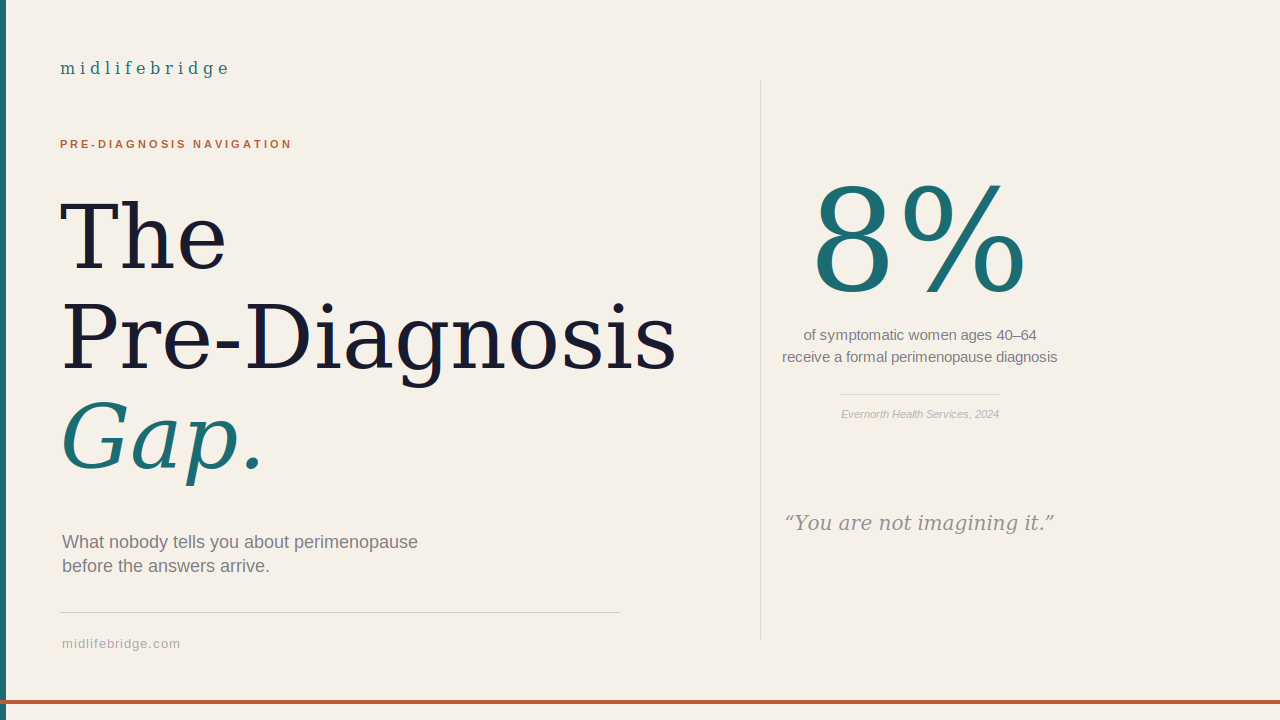
Pre-Diagnosis Navigation · Cornerstone Guide
By Kaia · midlifebridge · May 2026 · 18-minute read
Something is wrong. You can feel it.
You've felt it for months — maybe longer. The sleep that stops working. The brain fog that sits behind your eyes by mid-afternoon. The weight that appeared at your waist despite nothing changing. The anxiety that feels like it has no origin. The rage that arrives out of proportion to whatever just happened. The fatigue that a full night of sleep does not fix.
You go to your doctor. She runs labs. A few days later, you hear the words you have come to dread.
Everything looks normal.
Kaia's Voice
"I had been dismissed so many times I started to wonder if I was inventing it. I wasn't. None of us are. What we are living in — that space between something has clearly shifted and nobody has told you what — I call it the pre-diagnosis gap. And it finally has a name."
What Is the Pre-Diagnosis Gap?
The pre-diagnosis gap is the period — often lasting years — when a woman is experiencing the real physiological effects of hormonal transition, but has not yet received a formal diagnosis of perimenopause or menopause.
Her symptoms are real. Her biology is already changing. But the healthcare system has not yet acknowledged it — and in many cases, its standard tools aren't designed to.
A 2024 analysis by Evernorth Health Services reviewed data from 1.5 million commercially insured women between the ages of 40 and 64. More than half had experienced symptoms consistent with perimenopause or menopause. Only 8% had received a confirmed diagnosis.1
The other 92% were in the pre-diagnosis gap. Experiencing real symptoms. Without clinical acknowledgment. Navigating alone.
"More than half of women ages 40–64 have symptoms. Only 8% receive a diagnosis. The gap is not rare. It is the statistical norm."
8%
of symptomatic women ages 40–64 receive a formal perimenopause or menopause diagnosis1
4–8
years a woman typically spends in perimenopause — often without answers2
94%
of women received no education about menopause in school, entering this transition without a framework3
Why Your Labs Came Back Normal
This is the question I hear more than any other: If something is wrong, why doesn't it show up in my bloodwork?
The answer comes down to one word: fluctuation.
Standard hormone panels are designed to detect deficiency or excess — whether a value falls outside a reference range. What they are not designed to detect is the erratic swinging of hormone levels that characterises early perimenopause. Research documents that estrogen and progesterone do not decline in a smooth, predictable line during the perimenopausal transition — they fluctuate wildly, sometimes surging higher than they were in your reproductive years before beginning their eventual withdrawal.4
If your blood is drawn on a day when estrogen happens to be elevated, the result will look entirely normal. Which it is — on that day. The problem is that the test gives you a single snapshot of a system in constant, unpredictable motion. The fluctuations driving your symptoms may be real, and completely invisible at the moment of the draw.
This is one of the core structural reasons the pre-diagnosis gap exists. The tools most commonly used to rule out hormonal change were not designed for its earliest, most symptomatic phase.
What This Means for You
"A normal lab result does not mean nothing is happening. It means nothing unusual was detectable on that day. Those are two very different statements — and knowing the difference is the beginning of navigating this more effectively."
What Living in the Pre-Diagnosis Gap Actually Feels Like
Most health writing about perimenopause begins at the moment of diagnosis. midlifebridge begins here — in the years before that moment arrives, when you are trying to understand whether what you are feeling is hormonal, or psychological, or both, or neither.
The pre-diagnosis gap has a particular texture. It is rarely one dramatic symptom. It is a constellation of changes that, individually, could be explained away. The sleep disruption could be stress. The weight gain could be diet. The brain fog could be screens. The anxiety could be the world. The rage could be circumstance.
What makes it so disorienting is not any single symptom. It is the accumulation — and the absence of a framework to make sense of it.
Sleep disruption
Waking between 2 and 4am, often fully alert, sometimes with heat or anxiety. Not always accompanied by night sweats. Research shows progesterone's metabolite allopregnanolone promotes sleep onset via GABA-A receptor activity — when progesterone declines, this calming effect diminishes.5
Brain fog
Mid-sentence word loss. Difficulty with recall that feels distinct from ordinary forgetfulness. Cognitive cloudiness that does not lift with rest.
Fatigue
Not the tired-from-overdoing-it kind. The kind that sleep does not fix. Present regardless of how much rest you have had. Evernow's study of 100,000 women found that 85% of perimenopausal women reported fatigue and low energy.6
Mood changes
Heightened irritability, anxiety that feels baseline rather than situational, low-level sadness without clear cause. Over 70% of perimenopausal women in Evernow's study reported anxiety, depression, or mood changes.6
Metabolic shifts
Weight redistribution to the abdomen without changes in eating. Previous strategies for weight management becoming less effective. Research documents this as a genuine physiological shift related to estrogen's role in insulin sensitivity and fat distribution.7
Cycle changes
Shorter or longer cycles. Heavier or lighter flow. Spotting. Intensified PMS in cycles that were previously unremarkable. These often appear years before any other recognised perimenopause markers.
Joint pain
Achiness in hands, knees, and hips. Morning stiffness. Estrogen is believed to play an anti-inflammatory role in the musculoskeletal system; its fluctuation and decline is associated with increased inflammatory markers in joints and connective tissue.8
Loss of libido
Often one of the earliest symptoms and one of the least discussed. Rarely attributed to hormones by the women experiencing it or the providers they see.
Why Perimenopause Is So Hard to Diagnose
Menopause itself has a clear clinical definition: twelve consecutive months without a menstrual period. That moment can only be confirmed in retrospect. You cannot know you have reached menopause until a full year has passed since your last period. And because perimenopause is formally defined as the transition leading to that moment, it too can only be confirmed in retrospect — after the destination has already arrived.
This creates a practical problem: the phase that most women find most disruptive is also the phase that is hardest to clinically confirm in real time.
There is no single biomarker that definitively identifies perimenopause. Follicle-stimulating hormone (FSH) levels fluctuate substantially within and across cycles — an elevated FSH on one test can be followed by a normal FSH on the next. The World Health Organization and The Menopause Society both define perimenopause partly by clinical presentation: your symptoms, your age, and the pattern of what you are experiencing — not by a single lab threshold alone.9
A 2019 survey of US OB/GYN residency programmes found that only 6.8% of residents felt adequately prepared to manage menopause care — despite 93.8% saying such training was important.10 This is not an indictment of individual doctors. It is a structural gap in medical education that is only now beginning to be addressed.
What This Means for Your Next Appointment
You do not need to wait for a lab value to validate your experience. If you are in your 40s and experiencing a pattern of symptoms consistent with perimenopause, that is meaningful clinical information. Knowing this matters because it changes how you walk into a medical appointment. You are not there to be proven. You are there to be assessed.
Understanding the Hormonal Cascade
Your symptoms are not random. Research supports the view that they are connected — downstream effects of a hormonal transition that moves through every system in your body simultaneously.
Estrogen has receptors in the brain, the gut, the bones, the cardiovascular system, the urinary tract, and the skin. This is why perimenopause can present as cognitive changes, digestive shifts, joint pain, and sleep disruption — not just hot flashes and irregular periods. Understanding them as connected is the beginning of navigating the pre-diagnosis gap effectively.
01
Progesterone declines first
In most women, progesterone begins to decline before estrogen, as ovulation becomes less consistent. Research indicates that progesterone's metabolite allopregnanolone promotes sleep and reduces anxiety via GABA-A receptor activity; when progesterone declines, this calming effect diminishes.5 Sleep disruption and heightened anxiety are often the first signs.
02
Estrogen becomes erratic
Rather than declining smoothly, estrogen levels swing unpredictably during the perimenopausal transition.4 On higher-estrogen days: bloating, breast tenderness, heavy periods. On lower-estrogen days: brain fog, fatigue, low mood, vasomotor symptoms. Both are part of the same transition.
03
The stress response becomes more reactive
Research suggests estrogen modulates the hypothalamic-pituitary-adrenal axis, the body's stress-response system. As estrogen fluctuates, many women find stress harder to recover from and a low-level background anxiety more present — even in calm circumstances. This is an active area of research; individual experience varies significantly.11
04
Metabolism shifts
Estrogen plays a role in insulin sensitivity, fat distribution, and metabolic regulation. Research documents that as it declines and fluctuates, many women experience abdominal weight redistribution and reduced effectiveness of previous weight management strategies. This reflects a genuine physiological shift, not a failure of effort.7
05
The downstream effects compound
Disrupted sleep affects mood and cognition. Dysregulated stress response affects insulin sensitivity. Metabolic changes drive fatigue. Fatigue impairs cognitive function. Research documents each of these links individually. The value of understanding the cascade is not to predict your experience precisely, but to recognise that disparate-seeming symptoms may share a common hormonal origin.12
"This is not a list of unrelated complaints. This is one system in transition. Understanding that changes everything about how you navigate it."
What to Do While You Are Still in the Gap
The pre-diagnosis gap does not have to be a passive waiting room. There is meaningful work to be done here — work that will make your eventual clinical conversations more productive and your sense of agency over your own health more solid.
1 — Track your symptoms as a pattern, not a list
When do symptoms arrive? What precedes them? What makes them worse? Symptom data collected over 4–8 weeks becomes enormously useful in a clinical setting and begins to reveal the hormonal pattern beneath the surface. This is not journalling. It is evidence.
2 — Learn which labs to request — and when
Not all hormone tests are equally informative. The timing of a test within your cycle matters. Knowing to request FSH, estradiol, progesterone (timed to the luteal phase), DHEA-S, and thyroid function — and understanding what the results mean in context — changes the quality of information you receive. The midlifebridge Lab Reference Guide covers this in full.
3 — Prepare for your appointments
The average primary care appointment runs 15–20 minutes.13 Walking in with a documented symptom timeline, a list of specific lab requests, and a clear opening statement — "I have been tracking these symptoms for eight weeks and I believe I am in perimenopause" — is a different conversation than describing how you have been feeling and hoping the provider connects the dots. Medical advocacy is a skill. The pre-diagnosis gap is where you develop it.
4 — Understand the conversation about hormone therapy before you need it
Menopausal hormone therapy (MHT, also called HRT) has a complex history shaped significantly by a 2002 randomised trial from the Women's Health Initiative. Subsequent reanalyses by the trial's own investigators, and multiple independent studies, have substantially revised the understanding of its risk profile — particularly for healthy women who begin therapy within 10 years of menopause onset.14 The Menopause Society's current position statement holds that for most healthy women under 60 within 10 years of menopause onset, the benefits of hormone therapy for managing symptoms generally outweigh the risks, though this depends significantly on individual health history.15 Whether any treatment is right for you is a clinical decision to be made with your provider. midlifebridge does not recommend or advise against any specific treatment.
5 — Know what medical dismissal looks like — and prepare for it
Being told you are too young, that your labs are normal, or that this is just stress is one of the most common experiences in the pre-diagnosis gap. Knowing how to respond — how to restate your concerns, when to ask for a referral, how to find a provider who specialises in midlife women's health — is not pessimism. It is preparation.
The pre-diagnosis gap is real. It is common. It is not your fault, and it is not a life sentence.
What it requires is navigation. And navigation requires tools, structure, and a clear understanding of where you are and what you are moving toward. You are not imagining it. You are not alone. And there is a path through this.
midlifebridge
Start with the free quiz.
Know exactly where you are.
8 questions. 5 dimensions. Your results delivered to your inbox — with a clear picture of what to focus on first. No diagnosis required.
Take the free quiz →Or explore the full toolkit →
References & Sources
1. Evernorth Health Services. Research Finds That Few Women Receive Diagnoses of Perimenopause or Menopause. Analysis of 1.5 million commercially insured women ages 40–64. 2024. evernorth.com
2. Bolling K, et al. Characterization and Treatment Patterns of Peri/Menopausal and Postmenopausal Women. Womens Health Rep. 2025;6(1):742–751. DOI: 10.1177/26884844251366113. PMC12413248
3. Midi Health. Menopause Statistics, Facts & Latest Research. 2024. joinmidi.com. Note: Midi Health is a commercial telehealth provider. This statistic is cited for illustrative purposes; readers are encouraged to verify independently.
4. Santoro N, et al. Characterizing the perimenopause. Clin Obstet Gynecol. 2004;47(3):587–596. PMID 15326421. Also: Study of Women's Health Across the Nation (SWAN) longitudinal cohort data.
5. Lancel M, et al. Progesterone induces changes in sleep comparable to those of agonistic GABAA receptor modulators. Am J Physiol. 1996. PMID 8897866. Also: Cintron D, et al. Efficacy of Oral Micronized Progesterone for Sleep: A Systematic Review. J Clin Endocrinol Metab. 2021;106(4):e942.
6. Evernow. Evernow Menopause Study. Data from 100,000 women on perimenopause symptom prevalence. 2022. evernow.com
7. Davis SR, et al. Understanding weight gain at menopause. Climacteric. 2012;15(5):419–429. DOI: 10.3109/13697137.2012.707385.
8. Zhao H, Yu F, Wu W. The Mechanism by Which Estrogen Level Affects Knee Osteoarthritis Pain in Perimenopause. Int J Mol Sci. 2025;26(6):2391. DOI: 10.3390/ijms26062391. PMC11942494. Note: full causal role of estrogen in osteoarthritis outcomes is not universally agreed upon in the medical community.
9. Peacock K, Carlson K, Ketvertis KM. Menopause. StatPearls, NIH/NLM. Updated 2024. ncbi.nlm.nih.gov/books/NBK507826. Also: WHO. Menopause fact sheet. 2024. who.int
10. Sobel ME, et al. Survey of US OB/GYN residency programmes: 6.8% felt adequately prepared for menopause care; 93.8% rated such training as important. Menopause. 2019. Cited by: UVM Menopause Care Professional Certificate. learn.uvm.edu
11. Bale TL, Epperson CN. Sex as a Biological Variable: Who, What, When, Why, and How. Neuropsychopharmacology. 2015;40(11):2548–2559. PMC4576520.
12. Santoro N, Roeca C, Peters BA, Neal-Perry G. The Menopause Transition: Signs, Symptoms, and Management Options. J Clin Endocrinol Metab. 2021;106(1):1–15. PMC7765648.
13. Houston Family Physicians PA. The average appointment time in a primary care clinic. houstonfamilydoctors.com. Cross-referenced with: Swanson KM, et al. Association between primary care appointment lengths and subsequent ambulatory reassessment. BMC Fam Pract. 2022. PMC8900401.
14. Manson JE, et al. Menopausal hormone therapy and health outcomes during the intervention and extended poststopping phases of the WHI randomized trials. JAMA. 2013;310(13):1353–1368. PMC4166911. Also: Writing Group for WHI Investigators. JAMA. 2002;288(3):321–333.
15. The Menopause Society. 2022 Hormone Therapy Position Statement. Menopause. 2022;29(7):767–794. menopause.org/professional-resources/position-statements
Educational Content Notice: This article is for informational and educational purposes only. It does not constitute medical advice, diagnosis, or treatment, and does not establish a physician-patient relationship. Nothing in this article should be used to self-diagnose, initiate, change, or discontinue any medical treatment. Always consult a licensed healthcare professional about your specific health situation. Individual symptoms vary widely and may have causes unrelated to perimenopause. midlifebridge does not prescribe, diagnose, or treat any medical condition.
SUBSCRIBE FOR WEEKLY LIFE LESSONS
Lorem ipsum dolor sit amet, metus at rhoncus dapibus, habitasse vitae cubilia odio sed.
We hate SPAM. We will never sell your information, for any reason.